

close
Choose Your Site
Global
Social Media
Views: 0 Author: Site Editor Publish Time: 2026-09-16 Origin: Site


Seal integrity in flexible medical packaging dictates patient safety. Micro-leaks in fluid management systems lead directly to fluid contamination, dosage inaccuracies, or catastrophic failure during clinical use. When a compromised seal allows microbial ingress into an intravenous fluid supply, the results are immediate and severe. Manufacturing these products requires rigorous quality control on the production floor. Testing flexible films presents a fundamental physics challenge: elasticity. Flexible materials naturally expand under pressure. This expansion masks actual leaks and extends test times, making standard pneumatic testing impossible without specialized intervention.
You must match the specific bag type—whether it is an IV, blood, urine, dialysis, or biopharma single-use assembly—with the correct testing methodology. Implementing a medical bag leak detection machine involves integrating custom fixturing, precise pneumatic controls, and advanced sensor technology. This combination allows manufacturers to achieve 100% inline production testing without bottlenecking throughput or compromising measurement sensitivity.
Fixturing is Non-Negotiable: Accurate leak testing of flexible bags requires rigid restraining devices (like custom metal plate fixtures) to minimize bag volume expansion and stabilize pressure.
Methodology Dictates Sensitivity: Selecting between a pressure decay leak tester and vacuum decay leak detection depends entirely on whether the bag is empty, filled, or highly porous.
Application-Specific Requirements: A urine bag leak tester prioritizes high-throughput port testing, whereas a dialysis bag leak tester requires highly sensitive multi-chamber seal verification.
Compliance and Traceability: Modern testing equipment must support FDA 21 CFR Part 11 and ISO 11607 compliance through automated data logging and repeatable calibration.
Vendor Partnership: Successful implementation relies on selecting a vendor with deep medical device expertise, custom engineering capabilities, and a robust global support infrastructure.
Introducing compressed air into an unrestrained flexible bag triggers the balloon effect. The polymer film stretches and expands continuously as internal pressure increases. In a standard pneumatic test circuit, this continuous volume expansion causes the internal pressure to drop. To a pressure sensor, the pressure drop caused by elastic expansion is indistinguishable from the pressure drop caused by an actual physical leak in the seal. You cannot accurately measure a leak if the container volume is constantly changing.
The engineering solution relies on rigid physical restraint. Custom metal plate fixtures must enclose the bag entirely during the test cycle. By clamping the bag between precision-machined aluminum or stainless steel plates, you limit elastic expansion. The plates force the bag to maintain a fixed volume. Reducing the internal test volume increases measurement sensitivity. A smaller volume of air reacts more dramatically to a micro-leak, generating a larger, more easily detectable pressure drop in a shorter amount of time. We typically machine these restraining plates from 6061 aluminum, applying a hard anodized coating to achieve a 32 micro-inch surface finish that prevents film abrasion during clamping.
Production environments demand a strict balance between cycle time, test pressure, and leak limit sensitivity. Engineering teams often target stringent parameters, such as detecting a 0.16 sccm (standard cubic centimeters per minute) leak limit at 10 psig in under 20 seconds. Achieving this requires highly optimized pneumatic circuits that minimize internal dead space and utilize high-resolution transducers capable of detecting fractional pressure changes.
The testing medium itself must meet strict medical manufacturing standards. Introducing ambient shop air into a sterile or soon-to-be-sterilized medical device introduces particulate and moisture contamination. Inline production testing requires clean, dry compressed air (CDA) meeting ISO 8573-1 Class 1.2.1 specifications. Facilities must route the air through desiccant dryers and 0.01-micron coalescing filters. This ensures the internal surfaces of single-use bag assemblies remain uncontaminated prior to final packaging and sterilization.
The absolute pressure decay method involves pressurizing the restrained bag to a predetermined target, isolating the pressure source by closing a valve, and measuring the pressure drop over a specific time interval. The test cycle consists of four distinct phases: fill, stabilize, test, and exhaust. The stabilization phase allows the air temperature and bag material to settle before the actual measurement begins. If you skip the stabilization phase, the thermal friction from the fill air will cause a rapid pressure drop that mimics a leak.
This methodology proves highly effective for 100% inline production testing of empty single-use bag assemblies and medical components. A properly configured pressure decay leak tester provides rapid, repeatable results for dry products. The method carries inherent limitations regarding environmental stability. Pressure decay is highly sensitive to ambient temperature fluctuations. According to the ideal gas law, a drop in temperature causes a proportional drop in pressure. Testing environments require precise HVAC controls or polycarbonate machine enclosures to prevent drafts from triggering false reject signals.
The vacuum decay method operates on the opposite principle, conforming to ASTM F2338 standards. Operators place the bag inside a rigid, sealed test chamber. The system draws a vacuum within the chamber, creating a pressure differential between the inside of the sealed bag and the surrounding chamber environment. The system then monitors the chamber for any increase in pressure. If the bag has a leak, gas or liquid escapes from the bag into the chamber, causing the chamber pressure to rise.
This approach represents the industry standard for testing already filled and sealed medical fluid bags. Vacuum decay leak detection allows manufacturers to verify the integrity of final products without risking product contamination or requiring destructive testing. It identifies micro-leaks in the perimeter seals and port welds of filled IV bags, ensuring product sterility remains intact right up to the point of shipment. The tooling cavities must be custom-molded to match the exact profile of the filled bag to minimize the void volume in the vacuum chamber.
Mass flow testing measures the exact volume of air required to maintain a constant pressure inside the bag. Instead of isolating the pressure source and watching for a drop, the system keeps the pressure constant and uses a highly sensitive thermal mass flow meter to measure the makeup air flowing into the part. If the bag leaks, the system must continuously feed air into it to maintain the target pressure.
This method offers distinct advantages for large-volume bags, such as 1000ml to 3000ml fluid bags. Mass flow provides faster cycle times compared to pressure decay because it does not require waiting for extended pressure stabilization. The flow sensor reads the leak rate directly in standard cubic centimeters per minute (sccm), simplifying calibration and reducing the mathematical conversions required by standard pressure drop measurements.
Testing Method | Primary Application | Key Advantage | Primary Limitation |
|---|---|---|---|
Pressure Decay | Empty flexible bags, single-use assemblies | Highly accurate with rigid fixturing, fast cycle times | Sensitive to ambient temperature changes |
Vacuum Decay | Filled and sealed fluid bags | Non-destructive testing of final packaged product | Requires complex, custom-molded vacuum chambers |
Mass Flow | Large-volume empty bags (e.g., 1000ml+ bags) | Direct sccm measurement, shorter stabilization | Higher initial equipment cost for thermal flow sensors |
Intravenous and blood storage bags demand the most stringent leak limits in the medical packaging industry. These products directly enter the human bloodstream, meaning any microbial ingress presents an immediate, life-threatening risk. The materials, typically specialized PVC or polyolefins, must withstand sterilization, freezing, and rapid thawing without compromising seal integrity.
Testing these bags requires verifying both the perimeter RF (radio frequency) welds and the fitment/port welds. The transition zone where the injection-molded port meets the extruded film is the most common leak path. The restraining plates must feature precise cutouts that accommodate the spike ports and injection sites without pinching the tubes or leaving the port seals unsupported. Unsupported ports will expand and rupture under test pressure, destroying the product and halting the production line. We utilize custom urethane seals with a Shore 40A hardness to clamp around these ports safely.
Biopharmaceutical manufacturing increasingly relies on single-use bag assemblies (SUBs) for mixing, storing, and transporting high-value media and drug substances. These assemblies range from small 50ml 2D bags to massive 2000-liter 3D bioreactor bags. They feature complex networks of tubing, sterile filters, and aseptic connectors.
Point-of-use leak testing for these assemblies requires specialized equipment. The machine must accommodate complex, high-value assemblies without compromising sterility before use. Operators perform these tests in cleanroom environments immediately before filling the bag with active pharmaceutical ingredients. The test systems must utilize sterile barrier filters on the pneumatic lines and employ highly sensitive pressure transducers capable of detecting micro-leaks in massive internal volumes. Testing a 2000L bag often requires 10 to 15 minutes of stabilization time.
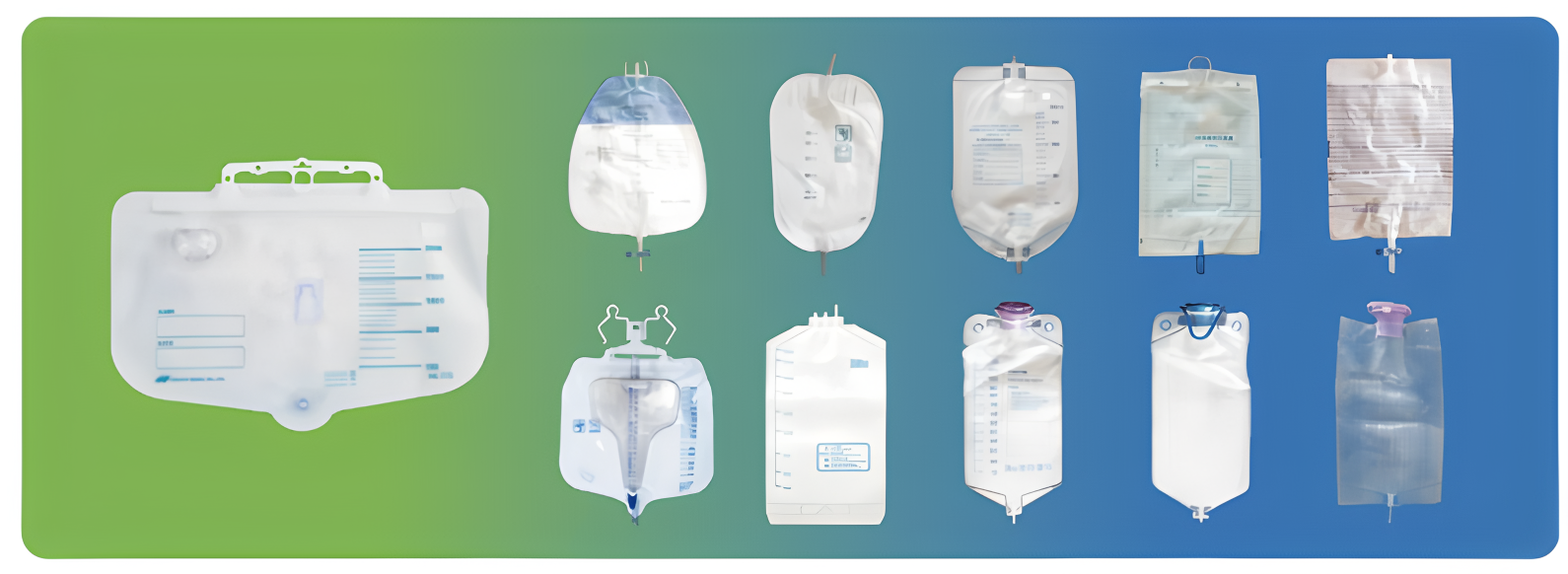
Urine drainage bags present unique manufacturing challenges due to their complex geometries. A standard bag features multiple integration points: a top inlet tube, an anti-reflux drip chamber to prevent retrograde infection, a sample port, and a bottom drainage valve, such as a T-tap or push-pull valve. Each of these connection points represents a potential failure mode during the high-frequency welding process.
A dedicated urine bag leak tester must accommodate these complex geometries while maintaining rapid changeovers for high-volume production lines. The custom restraining plates must encapsulate the entire bag while providing pneumatic clamping mechanisms to seal the inlet and outlet tubes automatically. High-throughput lines require multi-station rotary or linear indexing systems. This asynchronous setup allows one bag to undergo the stabilization and test phases while the operator unloads and loads the adjacent stations, keeping pace with welding machines that output a bag every 1.5 seconds.
Surgical and wound drainage bags handle highly viscous exudates and operate under continuous negative pressure. Manufacturers construct these bags from various materials, including heavy-gauge PVC, EVA (ethylene-vinyl acetate), and specialized polyurethanes. These materials are generally thicker and less uniform than standard IV films, requiring different handling and testing parameters.
Configuring a drainage bag leak detection machine involves calibrating the system to handle these thicker materials. The restraining plates require higher clamping forces—sometimes exceeding 1000 lbs of pneumatic force—to flatten the heavy-gauge films effectively. Wound drainage systems often feature multi-lumen tube connections. The test fixtures must utilize custom-molded seals to clamp around these irregular tubing profiles, ensuring a leak-tight connection during the pressurization phase without crushing the internal lumens.
Continuous Ambulatory Peritoneal Dialysis (CAPD) bags are highly complex, multi-chamber systems. They often contain different fluid formulations separated by frangible seals, commonly known as peel seals. The clinical user breaks these internal seals to mix the fluids immediately before administration. These frangible seals are engineered to rupture at specific, low-pressure thresholds.
A dialysis bag leak tester must navigate a delicate balance. It must pressurize the bag sufficiently to verify the integrity of the permanent outer perimeter seal, but it must strictly control the internal pressure to avoid accidentally rupturing the internal frangible seals during the test cycle. This requires high-precision electronic pressure regulators and customized restraining plates. The plates must feature a physical bar that presses down exactly on the peel seal zone, supporting it from the outside so it does not yield or rupture during the differential pressure test.
Bag Material | Common Application | Material Characteristics | Fixturing Requirements |
|---|---|---|---|
PVC (Polyvinyl Chloride) | Blood bags, standard IV bags | Highly flexible, prone to sticking | Teflon-coated plates to prevent adhesion |
EVA (Ethylene-Vinyl Acetate) | TPN bags, drainage bags | Thicker gauge, excellent low-temp durability | High-force pneumatic clamping cylinders |
Polyolefin Blends | Biopharma SUBs, specialized IVs | Low extractables, stiffer profile | Precision-machined edge reliefs to prevent weld crushing |
The sensor technology inside the testing machine is useless without proper physical fixturing. When evaluating equipment, you must assess the vendor’s capability to design and machine custom restraining plates. These plates must perfectly match the bag's geometry in its flattened state. Any voids or gaps between the plate and the bag allow localized elastic expansion, which absorbs the pressure drop of a micro-leak and results in a false pass.
Fixture tolerances directly impact test repeatability and false reject rates. The plates must feature precise cutouts for all ports, valves, and tubes. The clamping mechanism must apply uniform pressure across the entire surface area of the bag. Uneven clamping creates high-stress points that can damage the film or create artificial leaks during the test. We recommend utilizing guided linear bearings on the fixture press to ensure the top and bottom plates remain perfectly parallel during closure.
Production line speeds dictate the allowable cycle time for leak testing. Physics dictates an inverse relationship between test speed and leak sensitivity. Detecting a smaller leak requires a longer test time to allow the pressure drop to register on the transducer. The mathematical relationship is straightforward: Leak Rate = (Volume × Pressure Drop) / Time.
Calculating required cycle times requires establishing the specific test pressure and the target leak rate. Minimizing the internal test volume via tight-tolerance fixturing optimizes both variables. By reducing the volume of air inside the restrained bag, a given leak rate produces a larger pressure drop in a shorter time. This allows manufacturers to maintain high throughput without sacrificing sensitivity.
Medical device manufacturing operates under strict regulatory scrutiny. The software running the leak detection machine must comply with FDA 21 CFR Part 11 requirements for electronic records and signatures. This mandates secure user access controls, multi-level password protection that expires every 90 days, and unalterable audit trails. The system must log every parameter change, calibration event, and test result, tracking exactly who changed a test pressure from 10 psi to 8 psi and when.
The equipment must undergo rigorous validation processes. Adherence to ISO 11607 standards for packaging integrity is mandatory. A standard validation protocol includes:
Installation Qualification (IQ): Verifying all pneumatic and electrical connections match the engineering schematics.
Operational Qualification (OQ): Challenging the machine with calibrated master leaks at the upper and lower extremes of the operating window to ensure it catches known defects.
Performance Qualification (PQ): Running multiple consecutive production batches to establish the baseline false reject rate and verify long-term stability.
Integrating a leak testing system is not a one-time transaction. The production environment is dynamic, and equipment requires ongoing maintenance, calibration, and optimization. You must evaluate the vendor’s global support capabilities. Rapid on-site service, preventative maintenance programs, and remote technical troubleshooting minimize production downtime.
Partnering with manufacturers who offer deep expertise in medical device leak testing provides a significant advantage. Off-the-shelf pneumatic testers lack the specialized algorithms required to manage flexible film thermodynamics. Expert vendors provide comprehensive Factory Acceptance Testing (FAT) and Site Acceptance Testing (SAT), ensuring your team can troubleshoot minor issues, perform routine calibrations, and adjust parameters when introducing new bag materials to the line.
The most common cause of false rejects in pressure decay testing is environmental instability. Temperature drift directly affects pressure readings. If the ambient temperature in the manufacturing facility rises by a few degrees during a shift, the air inside the test bag expands. This expansion counteracts the pressure drop of a micro-leak, potentially allowing a defective bag to pass the test. Conversely, a sudden draft from an HVAC vent can cool the bag, causing a pressure drop that mimics a leak, resulting in a false reject.
Mitigation requires specifying machines equipped with advanced temperature compensation algorithms. These systems use external thermal sensors to monitor ambient conditions and adjust the baseline pressure readings in real-time. Automated baseline zeroing ensures the transducer resets to absolute zero before every cycle, eliminating sensor drift caused by atmospheric pressure changes.
Symptom | Potential Root Cause | Corrective Action |
|---|---|---|
High False Reject Rate | HVAC draft cooling the bag during test | Install polycarbonate enclosure around test station |
High False Pass Rate | Fixture cavity too large, allowing expansion | Remachine fixture plates to tighter tolerances |
Inconsistent Pressure Readings | Moisture or oil in the pneumatic supply line | Replace coalescing filters and service desiccant dryer |
Sensor drift over time presents a silent risk. If a pressure transducer loses calibration, it may fail to detect the minute pressure drops associated with micro-leaks. Relying solely on annual factory calibration leaves the production line vulnerable to months of undetected defects.
Mitigation involves implementing daily point-of-use leak testing validation. Operators must use calibrated leak standards, often referred to as master leaks. These are precision-manufactured micro-tubes, typically drawn glass or laser-drilled metal, that introduce a known, certified leak rate into the pneumatic circuit. By running a test cycle with the master leak engaged, operators verify that the machine accurately detects the specific leak limit before beginning the production shift.
Audit your current bag materials, port configurations, and production line speeds to define exact leak limit requirements and cycle time constraints.
Send physical bag samples to potential vendors for baseline feasibility testing to determine the optimal test pressure and stabilization times.
Request prototype fixture designs from vendors to ensure their restraining plates can accommodate all complex geometries, ports, and valves without pinching or damaging the film.
Verify that the vendor's software architecture fully complies with FDA 21 CFR Part 11 requirements for audit trails and secure data export.
A: A pressure decay leak tester combined with rigid restraining plates is the optimal method for testing empty flexible bags. For fluid bags that are already filled and sealed, vacuum decay leak detection serves as the industry standard, providing non-destructive verification without risking contamination.
A: Without rigid restraining plates, the flexible film expands elastically when pressurized. This continuous volume expansion causes the internal pressure to drop naturally. The testing machine cannot distinguish this expansion-induced pressure drop from an actual physical leak, leading to false failures.
A: Acceptable leak limits depend on the specific risk profile and fluid viscosity of the product. Blood and IV bags often target highly sensitive ranges, such as detecting a 0.16 sccm leak at 10 psig, to absolutely prevent microbial ingress and ensure patient safety.
A: No. Pressure decay testing measures the total pressure drop across the entire internal volume of the bag assembly. It confirms that a leak exists somewhere in the system, but it cannot pinpoint the exact location of the failure on the perimeter seal or port weld.
A: You must perform daily point-of-use validation using a calibrated master leak standard to ensure daily accuracy. Full system calibration, involving the pressure transducers and flow meters, should occur annually or immediately after replacing any major pneumatic components.
A: Yes. According to the ideal gas law, temperature fluctuations cause proportional changes in pressure. A sudden drop in ambient temperature cools the air inside the bag, causing a pressure drop that mimics a leak. Testing machines require temperature compensation algorithms to mitigate this.
